—— Powerful Blizzard “Hernando” Paralyzes NYC; CagriSema Trails Eli Lilly’s Tirzepatide in Trial, Shares Plunge 16.5%; Goldman Warns Hedge Funds Exiting Stocks at Fastest Pace Since 2025; Jamie Dimon to Defend 2 Billion Dollar Weekly Spending Plan; PayPal Draws Takeover Interest After Valuation Slump; AI Scare Trade Slams US Stocks; Private Equity Gripped by Liquidity Logjam
1. Powerful Blizzard “Hernando” Paralyzes NYC
A potent winter storm named “Hernando” has brought New York City to a standstill on Monday, marking what officials describe as the most significant blizzard to hit the region in at least a decade. Mayor Zohran Mamdani declared a local state of emergency, enforcing a citywide travel ban on non-essential vehicles from 9:00 PM Sunday through 12:00 PM Monday. As of 7:00 AM, Central Park had already recorded 9.3 inches of snow, with total accumulations in some areas forecasted to reach 24 to 28 inches (71 cm). The storm is accompanied by wind gusts of up to 60 mph, creating blinding whiteout conditions and raising the risk of coastal flooding.
The regional transport network has faced massive disruptions. The Long Island Rail Road (LIRR) fully suspended all service at 1:00 AM Monday, while Metro-North Railroad is operating on a significantly reduced hourly or weekend schedule. Aviation has been severely impacted, with over 60% of flights at JFK, LaGuardia, and Newark airports cancelled on Monday; total US flight cancellations have exceeded 8,000 across the two-day period. In a break from recent digital learning trends, Mayor Mamdani declared a traditional “snow day” for all NYC public schools, closing buildings and pausing remote instruction to ensure the safety of over 1 million students. Major institutions like Columbia University have pivoted to remote operations.
Residents are urged to remain indoors as high-water rescue teams and utility crews brace for potential flooding and power outages during the peak of the storm.

Bloomberg – Central Park Gets 15 Inches of Snow as Whiteout Stunts NY Travel
______
2. CagriSema Trails Eli Lilly’s Tirzepatide in Trial, Shares Plunge 16.5%
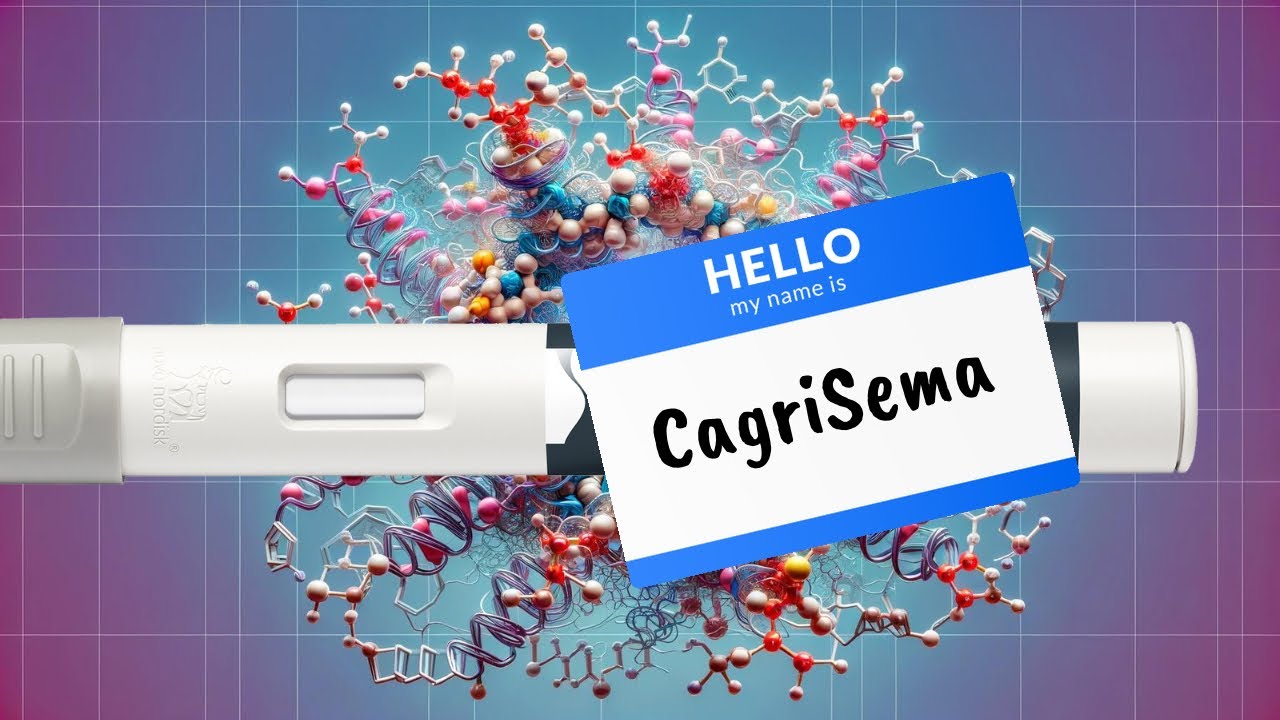
Novo Nordisk A/S suffered a significant blow on Monday as its next-generation obesity treatment, CagriSema, failed to outperform Eli Lilly & Co.’s rival drug Tirzepatide (marketed as Zepbound) in a highly anticipated head-to-head clinical trial. Results from the 84-week REDEFINE 4 study showed that patients treated with CagriSema achieved a 20.2% weight loss in a real-world analysis, compared to 23.6% for those on Tirzepatide. The trial failed to meet its primary objective of demonstrating that CagriSema was at least as effective (non-inferior) as its competitor. Following the announcement, Novo Nordisk shares in Copenhagen plummeted by as much as 16.5%, hitting their lowest levels since 2021, while Eli Lilly shares rose approximately 4% in U.S. premarket trading.
CagriSema is a fixed-dose combination of semaglutide (the active ingredient in Wegovy) and an experimental amylin analog called cagrilintide. While Novo’s R&D chief Martin Holst Lange highlighted that the drug achieved 23% weight loss under ideal clinical conditions, investors were spooked by its inability to beat Lilly’s existing blockbuster. The results are seen as a major obstacle in Novo’s efforts to reclaim its dominant position in the $100 billion obesity market. Despite the clinical miss, Novo submitted CagriSema for FDA approval in December 2025 based on separate pivotal studies, with a regulatory decision expected by late 2026.
The company now plans to initiate trials for a higher-dose version of CagriSema in the second half of 2026 to potentially close the efficacy gap.
Bloomberg – Novo Next-Generation Obesity Shot Falls Short of Lilly Rival
______
3. Goldman Warns Hedge Funds Exiting Stocks at Fastest Pace Since 2025
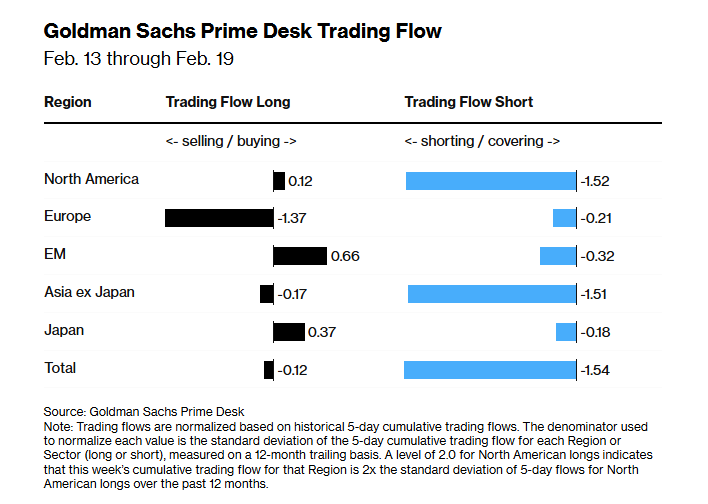
Hedge funds are offloading global stocks at their most aggressive pace since the early April 2025 “tariff meltdown,” according to a client note from Goldman Sachs’ Prime Services desk on Thursday. Net selling in the week ending February 19 hit a negative 1.4 standard deviation from typical levels, driven primarily by a surge in short positions. The exodus was most pronounced in North America and Europe, as investors grow increasingly skeptical that growth-linked equity gains can be sustained amid mixed economic data and a massive sell-off in AI-related software stocks. Consequently, the S&P 500 is on track for its worst monthly performance since last April.
At the sector level, seven of the 11 global industry groups saw net disposals, with financials experiencing the largest net selling as high valuations and regulatory concerns weighed on sentiment. The broader tech sector also faced a reckoning; the S&P 500 software and services index has tumbled nearly 18% so far in 2026, shedding over $1.2 trillion in market value. Despite the overall market turbulence, hedge fund performance in early 2026 remains solid as managers rotate into defensive sectors such as energy, healthcare, and staples.
Goldman’s traders noted that this shift—led by a reduction in long exposure in Europe and heightened shorting in the US—suggests professional investors are bracing for a period of sustained volatility and potential structural disruption from new AI applications.
Bloomberg – Hedge Funds Sold Most Global Equities Since April, Goldman Says
______
4. Jamie Dimon to Defend 2 Billion Dollar Weekly Spending Plan
JPMorgan Chase & Co. CEO Jamie Dimon will use a slimmed-down annual investor day in New York on Monday to justify a record $105 billion annual spending plan to shareholders. The strategy involves deploying roughly $2 billion a week toward recruitment, new branches, technology, and marketing. Despite a severe winter storm in the city, the bank confirmed it will proceed with the in-person event as scheduled. Dimon has previously urged investors to “trust him,” insisting that the aggressive investment is essential to ensure JPMorgan is not “left behind” by tech giants like Apple and fintech rivals like Stripe over the next decade.
As the largest U.S. bank by assets, JPMorgan’s 2026 expenditure marks a 10% increase from the previous year, significantly outpacing more modest programs from peers like Bank of America and Citi. Barclays analyst Jason Goldberg noted that no other bank has matched this “competitive response.” Buoyed by weekly profits exceeding $1 billion throughout 2024 and 2025, Dimon has refused to meet arbitrary expense targets, arguing that the industry is more competitive than at any time since the global financial crisis.
Wells Fargo analyst Mike Mayo observed that with $60 billion in excess capital above regulatory requirements, the “Goliath of Goliaths” is in fighting condition and ready for an aggressive expansion phase.
Financial Times – Dimon seeks to sell JPMorgan investors on $2bn-a-week costs bill
______
5. PayPal Draws Takeover Interest After Valuation Slump
PayPal Holdings Inc. is attracting preliminary takeover interest from potential buyers after a significant stock slide wiped out nearly half of its market value, according to sources familiar with the matter. The San Jose-based digital payments pioneer has reportedly held meetings with advisors to evaluate unsolicited interest from various suitors. At least one major rival is said to be considering an acquisition of the entire company, while other parties are focused on specific strategic assets. Following the Bloomberg report on Monday, PayPal shares surged as much as 9%, briefly triggering a volatility trading halt.
Once the dominant leader in online payments, PayPal has struggled recently as consumers pivot to alternative methods like Apple Pay and Google Pay. The company’s core branded checkout growth slowed to just 1% in the final quarter of 2025, significantly trailing industry peers. This operational slowdown, coupled with a surprise leadership change on February 3—naming Enrique Lores as the new CEO—and a disappointing 2026 profit forecast, has fueled investor unease. Over the past 12 months, PayPal’s stock has declined approximately 46%, bringing its market capitalization to roughly $38.4 billion.
While management is banking on new AI-driven partnerships with OpenAI to spark a turnaround, the current low valuation has made the fintech giant a prime target for consolidation, though a deal is far from certain.

Bloomberg – PayPal Attracts Takeover Interest After Stock Slump
______
6. AI Scare Trade Slams US Stocks
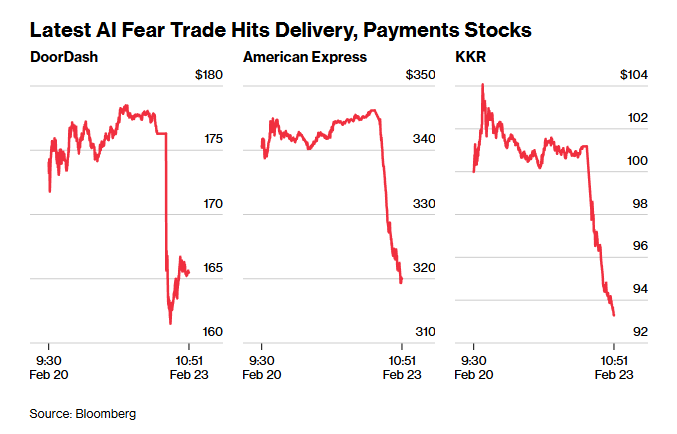
Shares in delivery, payments, and software sectors tumbled on Monday after Citrini Research published a provocative report titled “The 2028 Global Intelligence Crisis,” outlining potential existential risks posed by advanced AI agents. DoorDash Inc., American Express Co., and Blackstone Inc. all saw their stocks drop by more than 7%, while other major names including Uber, Mastercard, Visa, Capital One, Apollo, and KKR declined by at least 3%. Framed as a “memo from June 2028,” the analysis explores a hypothetical scenario where widespread adoption of autonomous AI agents dismantles the “habitual moats” of top service platforms and financial networks by perfectly optimizing for price and routing transactions through stablecoins to bypass traditional interchange fees.
The authors characterized the report not as a formal prediction, but as a thought experiment on “left-tail risks” that the market has significantly under-priced. A central thesis suggests that as AI agents replace high-earning white-collar workers—who drive roughly 75% of discretionary consumer spending—a “human intelligence displacement spiral” could trigger a collapse in demand. While corporate margins might initially surge as firms trade payroll for compute power, the resulting “Ghost GDP” could eventually lead to a broader economic pandemic. Even as analysts warn that the current sell-off likely overestimates immediate AI disruptions, the market has slipped into a defensive mode.
Prominent investor Michael Burry added to the buzz by sharing the research, sarcastically noting that his own bearish reputation pales in comparison to the scenario modeled by Citrini.
Bloomberg – Software, Payments Shares Tumble After Citrini Post on AI Risks
______
7. Private Equity Gripped by Liquidity Logjam
Paramount Skydance announced Friday that its 108 billion dollar hostile bid to acquire Warner Bros. Discovery (WBD) has cleared a critical US antitrust milestone. The company confirmed that the statutory waiting period under the Hart-Scott-Rodino Act expired without intervention from the Department of Justice (DOJ), removing a major legal impediment to the deal. This regulatory progress comes even as WBD remains officially committed to a rival 83 billion dollar agreement with Netflix. Paramount’s bid is notably bankrolled by Oracle founder and prominent Donald Trump donor Larry Ellison, who has provided a personal guarantee for over 40 billion dollars in equity financing.
The swift clearance is widely interpreted as a signal of favor from the White House, especially as allies of the President expand their influence across the media landscape. Unlike Netflix’s offer, which seeks only WBD’s studios and HBO, Paramount’s 30 dollar per-share all-cash proposal aims to acquire the entire company, including CNN and Discovery. Paramount argues its plan poses less regulatory risk than a Netflix merger, which would create a dominant streaming monopoly. Backed by additional funding from Jared Kushner’s Affinity Partners and Middle Eastern sovereign wealth funds, the Paramount deal is moving into a decisive phase.
WBD has been granted a seven-day waiver by Netflix to engage in final negotiations with Paramount before a scheduled March 20 shareholder vote to decide the future of the Hollywood giant.
Bloomberg – Private Equity’s Dry Spell Worse Than 2008 Crisis, Bain Says
______