—— Disney Beats Q1 Estimates with Record $10B Parks Revenue; Oracle Plans $50B Fundraising to Fuel AI Infrastructure; Bitcoin Slumps Below $80,000 as Declining Volumes Squeeze Crypto Exchanges; US and India Secure Major Trade Deal: Tariffs Slashed to 18%; Elon Musk in Advanced Talks to Merge SpaceX with xAI to Fund AI Ambitions; Princeton Shifts from “Growth” to “Focus” Amid Deepening Fiscal; Palantir Issues Explosive 2026 Outlook
1. Disney Beats Q1 Estimates with Record $10B Parks Revenue
Walt Disney Co. posted stronger-than-expected fiscal first-quarter results on Monday, February 2, anchored by a historic performance from its “Experiences” division. Total revenue rose 5% to $25.98 billion, surpassing the $25.7 billion consensus, while adjusted earnings per share of $1.63 beat the $1.56 analyst estimate. The Disney Experiences unit, which oversees theme parks and cruise lines, hit a record $10 billion in quarterly revenue with operating income rising 6% to $3.3 billion, driven by increased guest spending and the addition of new cruise capacity. Disney shares jumped 4.2% in Monday’s pre-market trading following the report.
The earnings beat arrives as Disney prepares to conclude its multi-year CEO search. According to sources familiar with the matter, the board is aligning on promoting Josh D’Amaro, the 54-year-old chairman of the Experiences division, to succeed Bob Iger as chief executive. A formal vote is expected as early as next week, ahead of the company’s annual shareholder meeting on March 18. While Iger’s “Entertainment” segment saw operating income decline due to higher marketing costs and a tough theatrical comparison to last year’s slate, the continued profitability of Disney’s streaming SVOD business ($450 million in OI) provided a stable floor.
With D’Amaro poised to take the helm, Disney reinforced its bullish outlook for fiscal 2026, projecting double-digit EPS growth and $19 billion in cash flow from operations.

Bloomberg – Disney Tops Forecasts on Record Park Sales Ahead of CEO Pick
______
2. Oracle Plans $50B Fundraising to Fuel AI Infrastructure
Oracle Corp. shares fell 3% in pre-market trading on Monday, February 2, after the company announced a massive $45 billion to $50 billion financing plan to fund its aggressive AI cloud expansion. The fundraising, confirmed in a Sunday statement, will be split between debt and equity, including a new $20 billion “at-the-market” (ATM) equity program and a one-time bond issuance managed by Goldman Sachs. Oracle intends to use the capital to build additional data center capacity for contracted giants like OpenAI, Meta, Nvidia, and xAI. However, the sheer scale of the raise has rattled investors, as the stock has already plunged 50% from its September 2025 peak, wiping out roughly $460 billion in market value amid fears of an AI investment bubble.
The financial strain of the AI race is becoming increasingly visible on Oracle’s balance sheet. According to Bloomberg data, the company’s free cash flow has turned negative and is projected to remain so until 2030 due to tens of billions in recurring spending on semiconductors and long-term data center leases. While Oracle’s remaining performance obligations (RPO) stand at a staggering $455 billion, analysts from TD Cowen and Jefferies warn of significant concentration risk, noting that a vast majority of future growth is tied to the survival of OpenAI, which itself faces a steep path to profitability.
As credit default swap (CDS) prices for Oracle’s debt surge to five-year highs, the company is also reportedly weighing structural job cuts of up to 30,000 positions to pivot resources toward its goal of hitting $144 billion in OCI revenue by 2030.
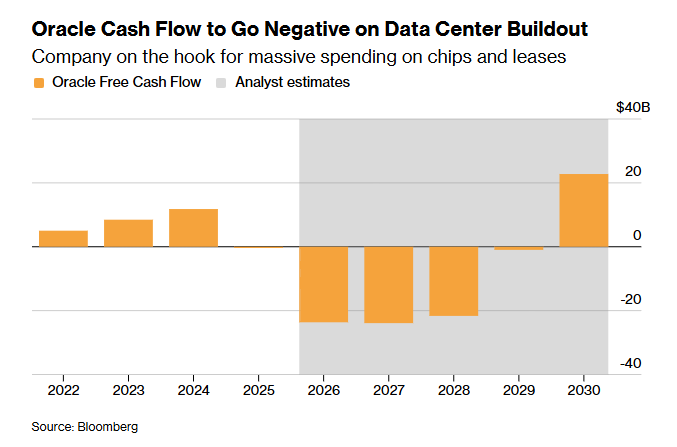
Bloomberg – Oracle to Raise Up to $50 Billion in 2026 for Cloud Buildup
______
3. Bitcoin Slumps Below $80,000 as Declining Volumes Squeeze Crypto Exchanges
The cryptocurrency market is facing a “crisis of absence” as Bitcoin tumbled below the critical $80,000 threshold over the weekend, hitting a nine-month low of approximately $75,700. Unlike previous bear markets defined by spectacular collapses like FTX, this downturn is characterized by a persistent lack of buying momentum and a “liquidity desert.” For top-tier exchanges like Coinbase, Gemini, and Bullish, the financial impact has been severe: trading volumes—their primary revenue engine—are on track to come in at less than half of last year’s levels. Coinbase, for instance, saw its projected Q4 volume drop by an estimated 40% to $264 billion, sending its stock price down over 40% in just three months.
The retreat from digital assets comes as institutional and retail conviction wavers. Spot Bitcoin ETFs, which saw record inflows in early 2025, have begun to bleed capital as prices dipped below the “realized price” (cost basis) of many fund holders. Analysts note that the market has failed to act as a hedge during recent geopolitical tensions, with capital instead rotating into physical precious metals or the resurgent U.S. dollar following Kevin Warsh’s nomination as Fed Chair.
Without a new catalyst to spark retail engagement, the industry faces an “agonizing” period of stagnant earnings and continued valuation compression for crypto-linked equities.

Bloomberg – Crypto Exchanges Buckle as Stock Losses Top 55% on Retail Exodus
______
4. US and India Secure Major Trade Deal: Tariffs Slashed to 18%
President Donald Trump announced a breakthrough trade agreement with India on Monday, February 2, following a decisive phone call with Prime Minister Narendra Modi. Under the pact, the United States will lower its “reciprocal” tariff on Indian goods from 25% to 18% and, more significantly, rescind the additional 25% penal duty previously imposed over India’s procurement of Russian crude. This effectively slashes the total tax burden on many Indian exports, including textiles and industrial machinery, from a peak of 50% down to 18%, providing much-needed relief to Indian manufacturers.
In return, India has committed to halting all purchases of Russian oil, pivoting instead toward American and potentially Venezuelan energy supplies. Trump claimed the deal includes a pledge from New Delhi to purchase over $500 billion worth of U.S. products across the energy, tech, and agricultural sectors, while also moving toward “zero” tariffs on American imports. While Prime Minister Modi hailed the 18% tariff reduction on “Made in India” products as a victory for the 1.4 billion people of India, New Delhi has yet to issue specific technical guidelines regarding the cessation of Russian oil flows.
Market analysts view the deal as a strategic pivot by India to safeguard its access to the U.S. market—its largest export destination—amid heightening geopolitical tensions.

Bloomberg – Trump, Modi Reach Trade Deal Slashing India Tariffs to 18%
______
5. Elon Musk in Advanced Talks to Merge SpaceX with xAI to Fund AI Ambitions
Elon Musk is in advanced negotiations to merge Space Exploration Technologies Corp. (SpaceX) with his artificial intelligence startup xAI, according to people familiar with the matter. The potential tie-up highlights how the billionaire’s AI goals have become too capital-intensive for a standalone entity to sustain. SpaceX and xAI have reportedly informed key investors of the plan, with an official announcement possible as early as this week. Musk personally signaled the validity of the reports by responding “Yes” to a post on X regarding the merger talks.
The deal would unite two of the world’s most valuable private companies: xAI, recently valued at $200 billion, and SpaceX, which reached an $800 billion valuation in December. The primary catalyst for the merger is xAI’s aggressive cash burn, currently estimated at $1 billion per month, driven by the massive computing power required for its Grok models.
By pooling resources, Musk aims to create a singular powerhouse capable of cross-leveraging SpaceX’s Starlink data and xAI’s processing capabilities while streamlining his hunt for massive capital in a tightening private market.
Bloomberg – Musk Is Said to Be in Advanced Talks to Combine SpaceX, xAI
______
6. Princeton Shifts from “Growth” to “Focus” Amid Deepening Fiscal
In his annual State of the University letter issued Monday, February 2, Princeton President Christopher Eisgruber delivered a sobering message to the campus community: the era of historic, unbridled growth has come to an end. Eisgruber warned that the Ivy League giant can no longer rely on the high endowment returns that fueled its expansion over the past three decades. “Princeton will continue to evolve, but in the future, it will more often have to do so through efficiency and substitution rather than addition,” Eisgruber wrote, signaling a multi-year transition toward budgetary austerity and operational streamlining.
The pivot is driven by a “perfect storm” of economic and political headwinds. Princeton’s $36.4 billion endowment, which funds 65% of the university’s $3.5 billion operating budget, has struggled with volatile returns, recording its second-worst three-year average since the 2008 financial crisis. Compounding these investment woes is a hostile legislative climate in Washington. The Trump administration’s 2025 tax overhaul raised the endowment levy for wealthy institutions to as much as 8%, potentially increasing Princeton’s annual tax liability by nearly $200 million. Furthermore, the suspension of federal research grants over “academic freedom” and “antisemitism” disputes has forced departments to implement 5% to 10% permanent budget cuts.
While the university remains committed to its record-breaking financial aid programs—now covering full tuition for families earning up to $250,000—Eisgruber made it clear that new initiatives will henceforth require the elimination of existing ones.

Bloomberg – Princeton Warns Budget Under Strain From Politics, Soft Returns
______
7. Palantir Issues Explosive 2026 Outlook
Palantir Technologies reported a 2026 fiscal year outlook on Monday that significantly outperformed Wall Street expectations, providing a needed boost for its struggling stock. The company projected annual revenue between $7.18 billion and $7.2 billion, far exceeding the $6.27 billion estimated by analysts. Fourth-quarter revenue grew 70% year-over-year to $1.41 billion, led by a staggering 137% surge in U.S. commercial revenue to $507 million.
While shares had dropped 29% from their November peak entering 2026, CEO Alexander Karp maintained a bullish tone in his shareholder letter. He characterized the accelerating revenue as a “cosmic reward” for the company’s long-term supporters. Karp’s letter framed Palantir’s momentum through a philosophical lens, citing the legacies of former Chinese leader Deng Xiaoping and American historian Christopher Lasch to underscore the importance of institutional resilience.
Despite the strong forecast, the stock continues to trade at a high multiple of 142 times expected earnings, the third-highest in the S&P 500.
Bloomberg – Palantir’s Revenue Forecast for Year and Quarter Lap Consensus
______